If you are heading to Dakhla to kitesurf and are considering staying at Auberge des Nomades du Sahara, this is the brutally honest, experience-based guide you wish someone had given you before booking. No marketing fluff. No Instagram filters. Just the reality of what it is actually like.
Where It Actually Is
The Auberge is located near the very end of the Dakhla lagoon, right next to Dakhla Camp. It is quiet and far from the city — exactly what you would expect from a kitesurfing lodge in the desert.
Dakhla has an interesting history. It was once a small fishing village, but over the last 5–6 years, it has transformed into a mekka for kitesurfing. The region is located in southern Morocco, about 400 kilometers from the Mauritanian border, in the disputed territory of Western Sahara — an area controlled and now claimed by Morocco.
Due to the tourism boom, Dakhla has undergone major infrastructure upgrades:
- New roads
- Street lighting
- Improved services
- And even a massive new hospital currently under construction
All of this is driven by the rapid growth of kitesurfing tourism.
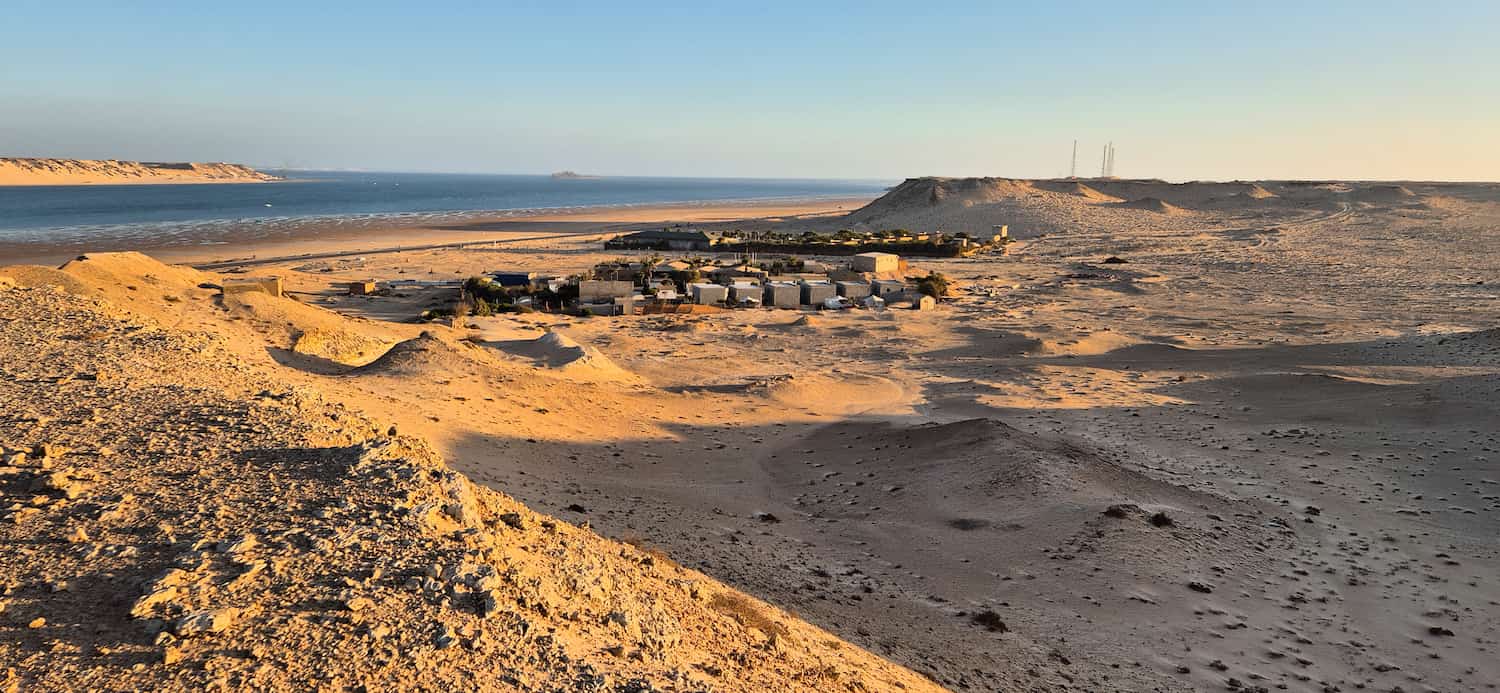
Auberge des Nomades seen from the top of the adjacent hill with the mighty lagoon stretching out in the background.
From the auberge itself:
- The lagoon is right in front of you.
- The Atlantic Ocean is about a 30-minute walk across the desert.
- There is nothing nearby except sand, wind, and kiters.
If you want nightlife, cafes, or shopping, this is not the place. If you want wind and water, you are in the right spot.
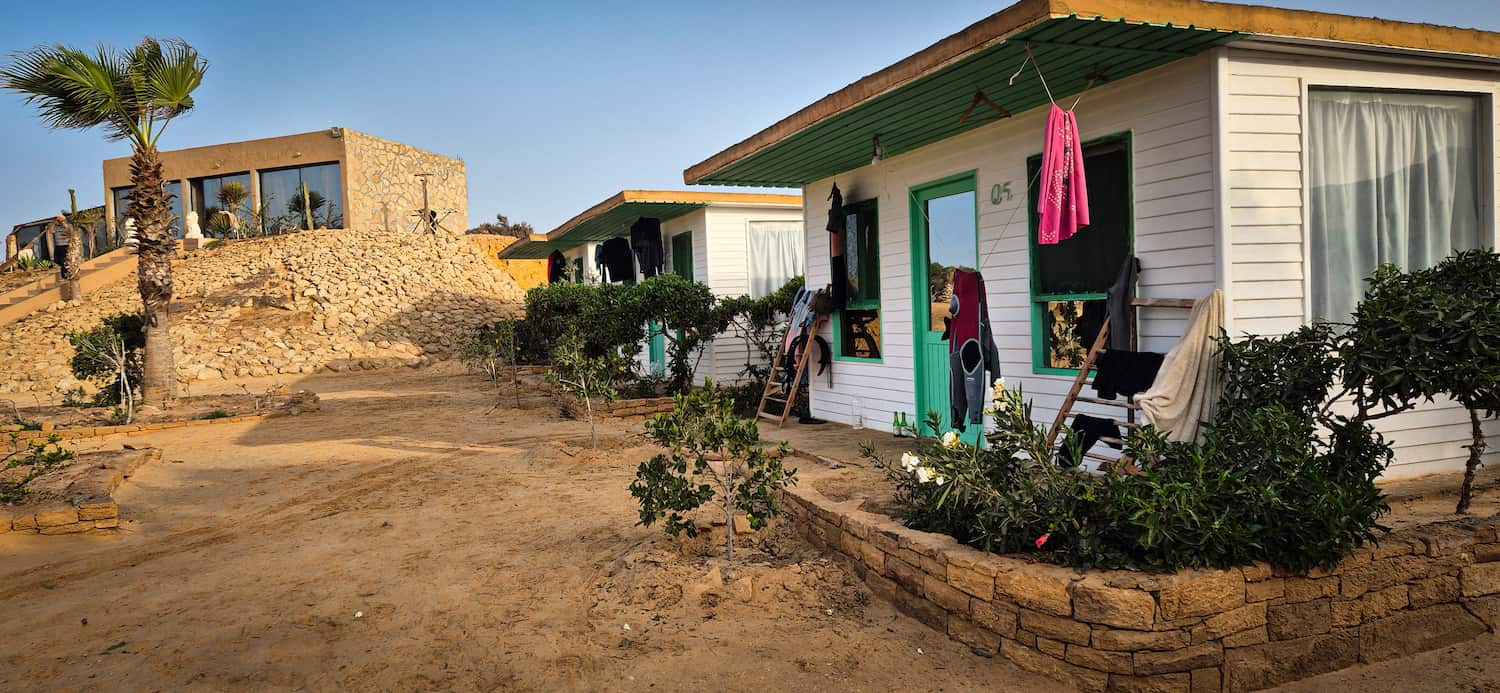
The white and green outdoor wooden cabins and bungalows at Auberge des Nomades du Sahara.
The Local Kite Center
The camp has its own kite center, primarily equipped with older F-One gear that has definitely seen better days. Rental prices were cheaper, but you will often see kiters coming back with broken equipment — ripped canopies, broken valves, worn-out bars, and everything in between.
The camp has its own kite mechanic, so if your gear fails, you can get it repaired on-site (for a fee). Still, many guests choose to rent from Dakhla Camp next door, which offers newer Duotone gear that is noticeably more reliable.
The auberge also has an open storage area where you can keep your own gear, though it is very basic and exposed to the elements.
Booking — Do It Well in Advance, and Expect Very Relaxed Communication
Reserve your spot well ahead of time. The auberge is extremely popular among French travelers, and spaces sell out quickly — especially during the windiest months.
Also, prepare yourself for a very… let's just say relaxed communication style.
When you book:
- You don't use an online reservation system
- You don't fill out a form on their website
- Instead, you receive an Excel document in French
- You fill it out and email it back to confirm your stay
It is old-fashioned, slow, and at times confusing — but that is simply how they do things. Do not expect quick replies, and don't panic if it takes them a few days to answer. It is completely normal.
The Rooms — Sharing Is the Standard
Auberge des Nomades du Sahara is built around community, so expect to share. Rooms come in various sizes — from double rooms to larger shared rooms holding up to five people — which means you will be living closely with other travelers, their habits, and their rhythms.
You can book a private room if you want more peace and quiet, but it comes at a noticeably higher price tag.
Snoring is guaranteed, so earplugs are indispensable. And don't be surprised if you are asked to switch rooms once or twice during your stay. As guests check out, the staff reshuffles people to make the best use of the space — it is entirely normal here.
The toilets are shared and decent, while the showers tend to get sandy throughout the day because kiters rinse off right after their sessions, bringing half the lagoon inside with them. Cleaning in the restroom area happens several times a day, but expecting clinical cleanliness in a desert kite camp is not realistic.
The Stay — Simple, Functional Rooms
The rooms themselves are simple but functional. Every window has a fly screen, the curtains are basic and a bit worn, and a single lamp provides most of the light. You will find three or four power outlets that often hang a bit loose from the wall — they work, but just barely.
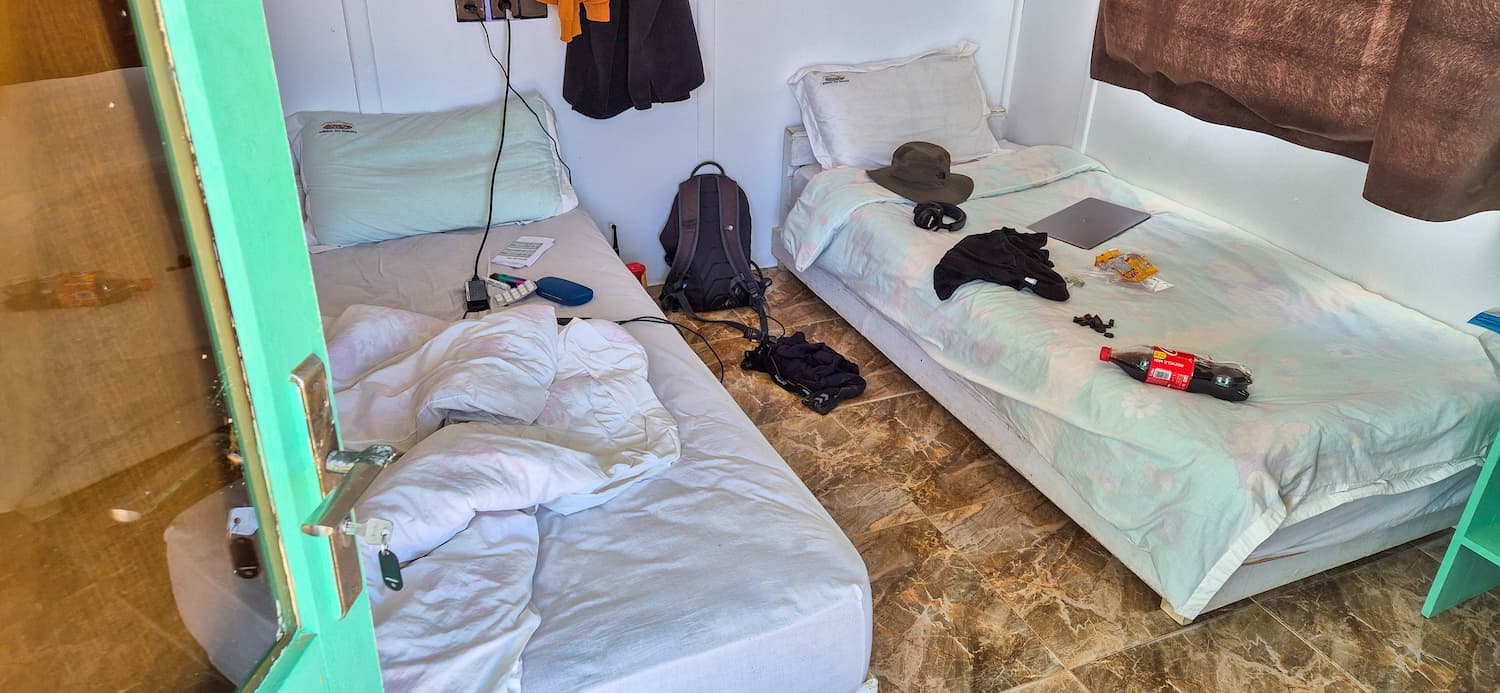
Inside one of the simple, shared rooms with two made beds, a backpack, and personal belongings at Auberge des Nomades du Sahara.
There is no housekeeping service, so the sand piles up quickly. After a windy day, you will find it in your sheets, on the floor, inside your bags, and basically everywhere. It is part of the desert experience, and you will be sweeping often if you want to keep it tidy.
Each guest gets their own bed and space in an open wardrobe for personal belongings. It is not luxurious, but it is completely sufficient if you are not picky. The focus here is not on design or comfort — it is about having a place to sleep after long days on the water.
You might also encounter an occasional cockroach racing across the floor, and if you leave the door open, expect a room filled with annoying flies within minutes. It seems the rooms get sprayed with insecticide from time to time to keep things under control, but in a warm desert environment, you never get rid of them completely.
Food — Sweet Breakfasts, Simple Lunches, and Loud Dinners
Meals at the auberge follow a predictable rhythm, and after a few days, you know exactly what to expect.
Breakfast is always on the sweeter side:
- Toasted bread
- Jam and syrup
- Cakes or pastries
- Hard-boiled eggs (often boiled a bit too long)
- Orange juice
- Coffee and tea
It fills you up, but it gets boring after a few days, especially if you prefer something savory in the morning.
Lunch is usually a rotation of:
- Tagine
- Couscous
- Pasta salads
- Chicken (very common)
- Occasional fish
Once a week, the camp hosts a barbecue night for 30 euros. It is a nice change of pace, but the price is definitely on the high side for what you get.
Dinner is where things get lively — sometimes a bit too lively. With a majority of French guests, the dining hall turns into a wall of enthusiastic conversation. It can get so loud that you end up sitting in silence simply because you cannot hear yourself speak.
Show up on time for meals. People tend to dig into what is served immediately, often taking second helpings without waiting for those who haven't arrived yet. Consideration isn't always part of the dining culture here.
Nighttime — Dogs, Wind, and Party Energy
Nights in Dakhla can be surprisingly chilly, so bring long pants and a windproof layer. You might think being in the Sahara means warm, balmy evenings, but the Atlantic breeze cuts right through the camp and cools everything down fast.
Most evenings are spent on the terrace, talking kitesurfing and sharing stories until dinner is served between 20:00 and 21:30. After dinner, the night splits into two groups: some grab their alcohol and keep the evening going with music, dancing, and laughs, while others head straight to bed to rest up for the next day's session.
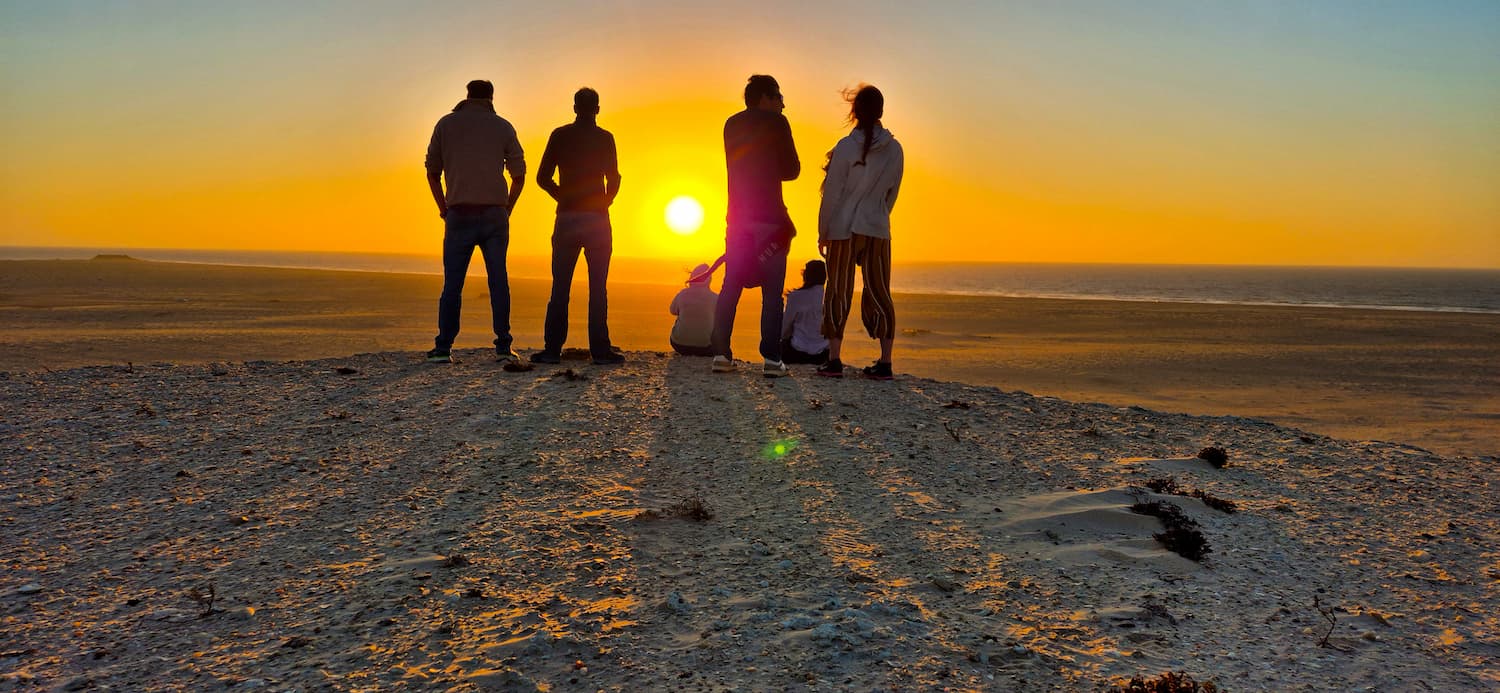
When the sun goes down, people gather on the hills to enjoy the last golden light over the raw desert landscape.
Alcohol is not banned, but the auberge is not allowed to sell it, so you have to bring your own. And if you run out, the local guys can usually "make something happen" with a bit of desert magic.
One thing you will hear from time to time is territorial fights between dogs. A handful of desert dogs roam the area, and when they get too close to the camp, the resident camp dogs bark out warnings. During my stay, there were several night fights — loud, chaotic, and frankly a bit unsettling. One morning, one of the smaller camp dogs was limping after a bite to the shoulder. Fortunately, the staff looks after them and patches them up when necessary.
Still, most nights are peaceful. When the wind dies down and the camp settles, the only sounds are bushes and palm trees swaying in the breeze.
The Kite Scene — Busy, Chaotic, and Full of Life
Dakhla has changed a lot since I first visited 5–6 years ago. Back then, the lagoon felt spacious with maybe a quarter of the riders you see today. Even though May is considered a quieter month compared to July and August, the lagoon was still very crowded at times.
At the upper end of the lagoon near the auberge, you will find a mix of:
- Beginners learning kite control
- Wingfoilers everywhere — many of them wobbling, standing up for two minutes, and crashing back in
- New kiters occasionally slamming their kite into the water just a few meters away from you
- Experienced riders pulling tricks and drifting 30–40 meters downwind
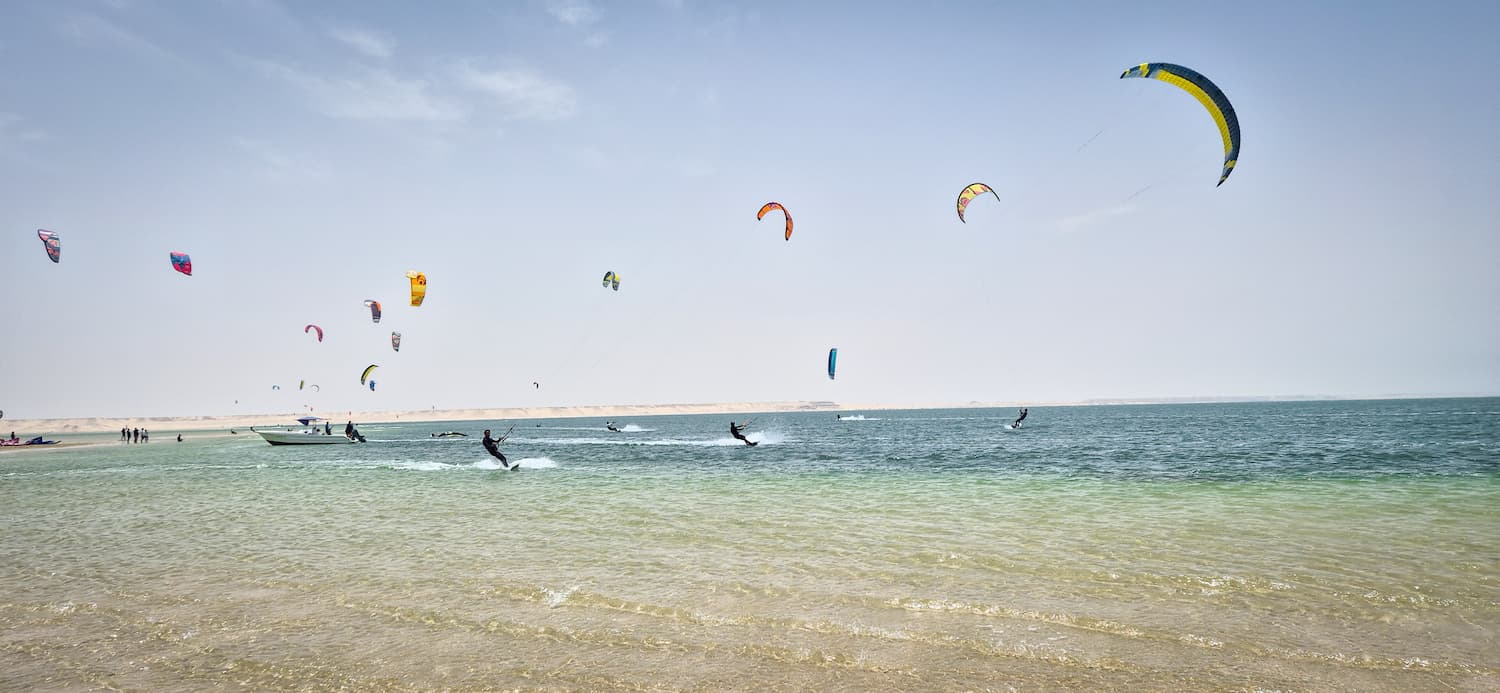
Kitesurfers performing a high jump and freestyle tricks over the glassy, flat water at the famous Speed Spot in Dakhla, with desert mountains and other kites in the background.
It is lively, chaotic, and at times a bit wild.
To avoid the crowds, I often rode in the light morning wind, just enough for a quiet "whisper" session. For the first two hours of the day, I practically had the lagoon to myself before the 12m kiters started showing up.
The same pattern worked in the afternoon:
- Right after lunch at 14:00 was excellent
- And again from 18:00 to 20:00, right before dinner
Wind-wise, there was enough to ride every day, but it was unstable at times. Since the wind crosses the desert from the Atlantic, it becomes gusty, with sudden drops followed by full power again 10–15 minutes later.
During the first week, the wind was strong and steady — I was on a 10m² almost the entire time. In the second week, the wind dropped, so mornings before lunch called for 15m² sessions, and after lunch, the 12m² came into play.
It is a dynamic spot: sometimes super smooth, other times hectic, but always rideable.
Speed Spot, Downwinders, and Escaping the Chaos
The Speed Spot behind the mountain is no exception to Dakhla's growing popularity. At low tide, the narrow strip of flat water quickly fills up with pro and advanced riders. Despite the crowd, it is surprisingly well-organized: kiters take turns using the thin sheet of water to boost, throw tricks, and then tack back upwind to try again. It has become a hotspot for training, and its popularity has surged dramatically in recent years.
Once a week, the auberge organizes a downwinder to the White Dune for around 35 euros. You start from the camp, ride down the lagoon, stop for a quick session at the dune, and eventually finish at the Secret Spot — a location gaining traction as more riders look for alternatives to the chaos of the main lagoon.
If you want to escape the crowds completely, you can also pay 20 euros for a 4x4 trip directly to the Secret Spot and enjoy the quieter lagoon there. It is a fantastic option if you prefer space, flatter water, and a noticeably more relaxed session away from the hustle.
Why Choose Auberge des Nomades du Sahara
The simple answer is community. It is the one thing Auberge des Sahara offers that no other camp on the main lagoon can match. The atmosphere is laid-back, social, and genuinely welcoming. The staff often sit with guests on the terrace to play cards, chat, or just hang out. Many speak English, some don't, but everyone makes an effort. The owner — a young Moroccan guy — and his brother are particularly warm and present.
There is a very special and strong sense of community here, where you strike up conversations in no time, and there is almost always someone to share a story or a cold drink with, no matter what time of day it is.
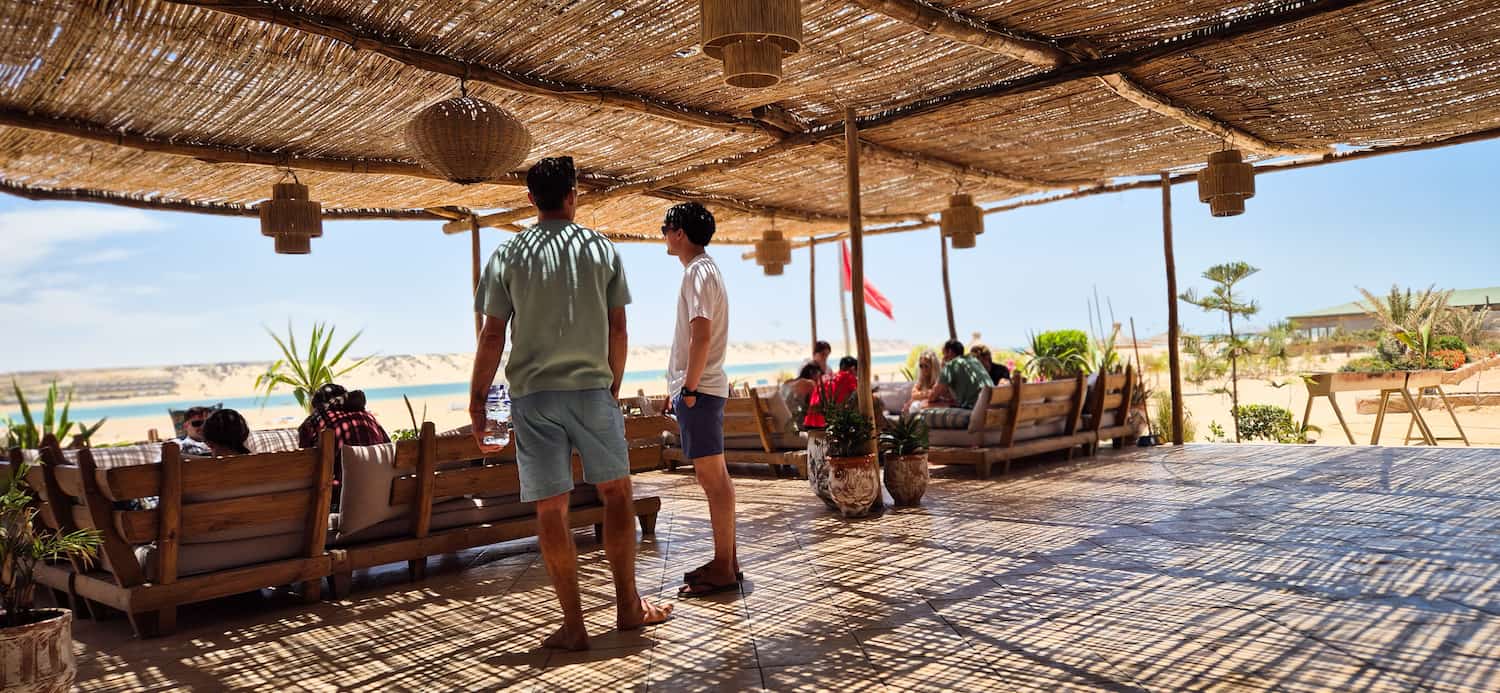
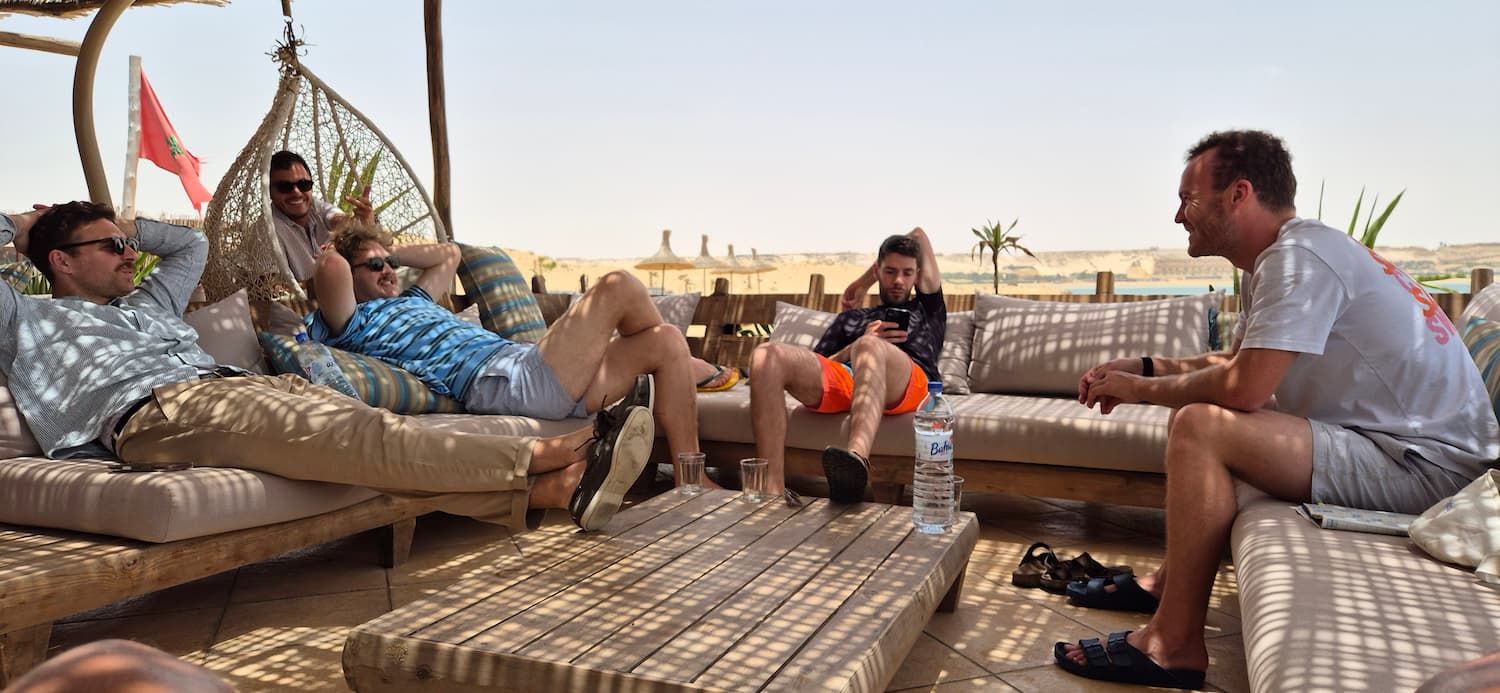
Mornings are slow and cozy: people relax on the terrace with a cup of coffee and a good breakfast, talking about yesterday's session and enjoying the silence before the wind really picks up. It feels more like a shared home than a hotel.
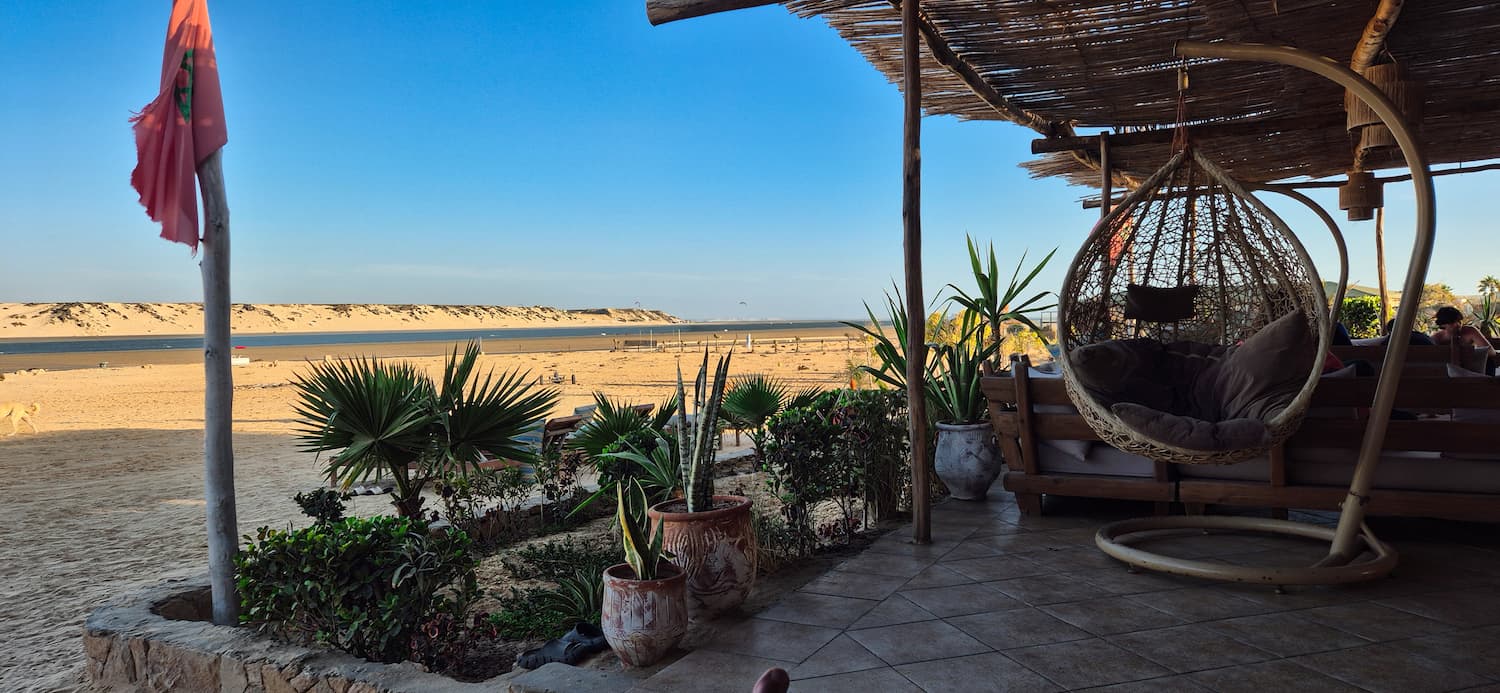
Quiet morning vibe on the cozy outdoor terrace with a wicker hanging chair at Auberge des Nomades with the open beach in the background.
If that is not your style, then Dakhla Camp next door is the alternative. For around 100 euros for a double room (50 euros per person), you get:
- Private toilet
- Cleaner and more comfortable rooms
- Better facilities
- A swimming pool
- A greener environment with grass and flowers
But what you *don't* get is the sense of community. At Dakhla Camp, guests tend to keep to themselves, and the staff is more formal. You don't get the same spontaneous conversations, shared laughs, or that feeling of belonging that defines Auberge des Sahara.
In short:
- Auberge des Nomades du Sahara = community, relationships, simplicity
- Dakhla Camp = comfort, facilities, privacy
It all depends on what you value most.
Read More About Dakhla
Thinking about traveling to Dakhla? Check out our in-depth guide to the incredible Secret Spot in Dakhla.
You can also find many more reviews, travel hacks, tips, and tricks on our main kite and surf blog.